Levels of Meaning
Check the meaning of any of the terms below that you’re unsure about:
- Metonym
- Rhetoric
- Symbol
- Connotation
- Innuendo
- Euphemism
Before you read on, give some thought to how you might apply these terms to your photographic practice or how you’ve seen them used in another photographer’s practice.
I have come across a few of these terms before, and have done some research into the others that I have not heard of.
Euphemism
Euphemism in art refers to using an image as a representation of something that is seen as objectionable.
Innuendo
Innuendo is where something is used as an insinuation, which then is interpreted as something sarcastic or derogatory.
Connotation
Connotation in an image refers to what is symbolised. It is a theory of what is seen and interpreted.
Symbol
Symbol is often self-explanatory. It can take the place of something that is difficult to present in an image. Symbols can be specific objects that relate to something else, something recognisable. They can also represent a narrative.
Metonym
The term originates from the Greek, meaning ‘change of name’. Metonymy is where an object or word has been replaced with another word where both have similar meanings. One famous example can be found in Shakespeare’s Julius Caesar; where Mark Antony states “Lend me your ears”. Another example is where you have an image of a graveyard, this could be another visual of death. We can see this in our everyday lives, in America for example, it is quite common to refers to the Oval office as a metonym for the US government. Or Hollywood as a metonym for a film industry.
Rhetoric
There can be two ways to look at rhetoric. I first heard of it when looking at Aristotle. To Aristotle, rhetoric is “the ability, in each particular case, to see the available means of persuasion” (Aristotle quoted in Mesa). There are three approaches. The first is Ethos, which is ‘based on the character of the speaker’. The second is Logos, which is ‘based on the logic or reason’. Lastly is Pathos, which is ‘based on emotion’.
The other was to look at rhetoric comes from Roland Barthes. In The Rhetoric of the Image, Barthes classified three messages that can be found within an image.
Linguistic Message
The first is the linguistic message, which refers to any text. This can take the form of a denoted message such as a caption, or a connoted message, where a word can allude to a symbolic meaning. Then also in the linguistic message, there is anchorage and relay. Anchorage is anchors the meaning to the correct or most appropriate of all the possible meanings. Relay adds context to the image, so both work together.
Symbolic Message
The next is the symbolic message, which is also known as the connoted image. This refers to the parts of an image which signal the symbolic meaning. Images may have several meanings, which have several different symbols. There will be several connotations in an images, which can be used as signifiers, these connotations make up the rhetoric. Essentially everything that can be used as a signifier, makes up the rhetoric of the image.
Literal Message
The literal message is also known as the denoted image. The non-coded version shows exactly what it is. The denoted image contributes to the structure of the image. It supports the connotations. According to Barthes, a pure image would arise when you remove all of the connotations.
I believe my work may relate to rhetoric, symbol, connotation and to an extent metonym. My images have a deeper and hidden meaning which is alluded to and viewers can come to their own conclusions. My work shows signs of metonymy. For example, I am showing pilgrimage which is a metonym for a journey, and I am depicting churches which alluded to a christianity. My work also shows signs of symbolism. My images contain several things that signify and symbolise the gender inequality and religion. These connotations also show my work lies within the rhetoric and connotation umbrella.
Bibliography
Art & Popular Culture. Innuendo. At: www.artandpopularculture.com/innuendo(Accessed on 10th of December 2019).
Encyclopaedia Britannica. Metonymy. At: https://www.britannica.com/art/metonymy(Accessed on 10th of December 2019).
McCabe, H (2009) The Rhetoric of the Image – Roland Barthes (1964). At: https://tracesofthereal.com/2009/12/21/the-rhetoric-of-the-image-roland-barthes-1977/ (Accessed on 10th of December 2019).
Mesa CC. The Art of Rhetoric. At: http://www.mesacc.edu/~bruwn09481/Syllabi/documents/htm/ArtRetoric/index.htm(Accessed on 10th of December 2019).
New World Encyclopedia. Denotation and Connotation. At: https://www.newworldencyclopedia.org/entry/Denotation_and_connotation(Accessed on 10th of December 2019).
Nordquist, R (2019) What Are Visual Euphemisms? At: https://www.thoughtco.com/visual-euphemism-1692489 (Accessed on 10th of December 2019).
Oxford Reference. Denotation and Connotation. At: https://www.oxfordreference.com/view/10.1093/01/authority.20110803095710580(Accessed on 10th of December 2019).
Smithsonian. Symbols in Art. At: www.smithsonianeducation.org/idealabs/myths/symbolsinart/ (Accessed on 10th of December 2019).
Look through some of your favourite books and consider how the sequencing guides you through the narrative, what decisions do you think have been made and why?
What are the results of those decisions for the reader?
I looked through a few books, including one I am reading at the moment, and they all have similar sequencing themes. The books starts by introducing the characters, or an event which either is the focus point or is going to lead up to the main story. The characters/event develops and interacts with each other. A plot is clearly identified, the reader here can have some ideas of how the story will unfold. The endgame is not given away fully yet, it leaves enough for the reader to guess at. All the plot lines eventually weave and led to the main climax. At this point the reader can see how the story has unfold and how the conclusion has been reached. Usually the ending, either ties a few things up with the characters and sometimes even leaves an open ending for a sequel. These sequencing choices guide the reader through the story, but it also allows room for imagination and lets the reader come to their own conclusions; at the end, they get to see if they were right.
Dewald Botha is a Level 3 OCA Student. Have a look at his project Fame and note some of the effective uses of sequencing and the impact it has on the unfolding narrative. Also consider how it makes you respond to the images.
Think about things like heightened suspense, a change in the direction of the narrative and how the sequencing guides the viewer’s response.
I watched the video on Dewald Botha’s work. The video starts with a picture, to be honest I was wondering where this could go. The next frame included the words “Zeng Kaiqui did it”, I was left wondering who this is and what he has done. The next frame gave a date and a location, “January 6, 2012” in “Nanjing, China”, this gives context to the story line. The next frame states “shot and robbed a man outside a bank”, we now know what this man has done, I am presuming that this man is the one from the poster on the first frame. “So someone stuck his picture…everywhere”, we know can draw the conclusion that the man in the posters is the man who committed these crimes. Next follows a question, “so that we can feel…a little safer?”, it feels like Botha is trying to reason why these posters were put up. But he raises just one reason, it is left to the viewer to figure out why. I don’t think there was a change in the direction of the narrative as such, it just developed. The sequencing was good, as it got the viewer thinking. Personally I would have preferred a slightly longer gap between the text frame, in order to build the suspense and to encourage viewer interaction (Botha, 2012).
Bibliography
Botha, D (2012) Fame. At: https://player.vimeo.com/video/74703746 (Accessed on 13th of December 2019).
Knorr uses her sequences of images to put across a particular political point of view. You may not have a political agenda but you probably have some idea or viewpoint that you want to convey to your viewers. In a couple of sentences, write down what that is, then make notes on how you might use some of the techniques discussed in Part Three to help convey your idea(s) to the viewer.
Have you considered how you will use text in your project? Will this be through individual captions or are you planning a more extensive textual element? Make some notes in your learning log or blog.
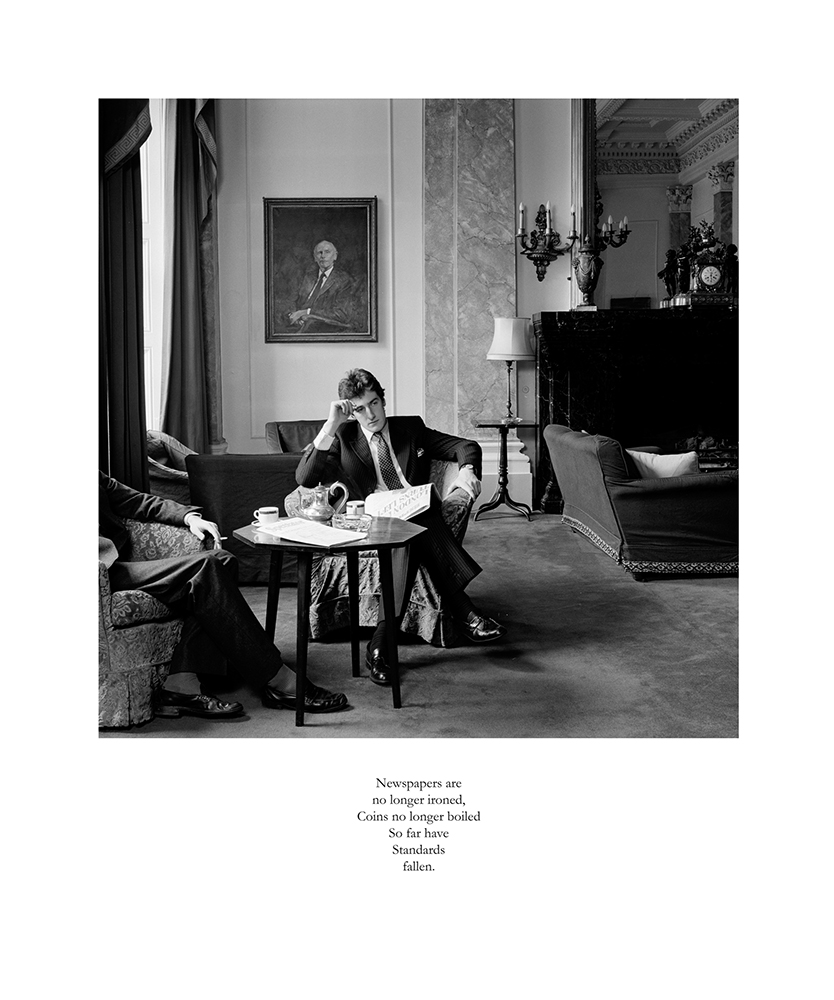
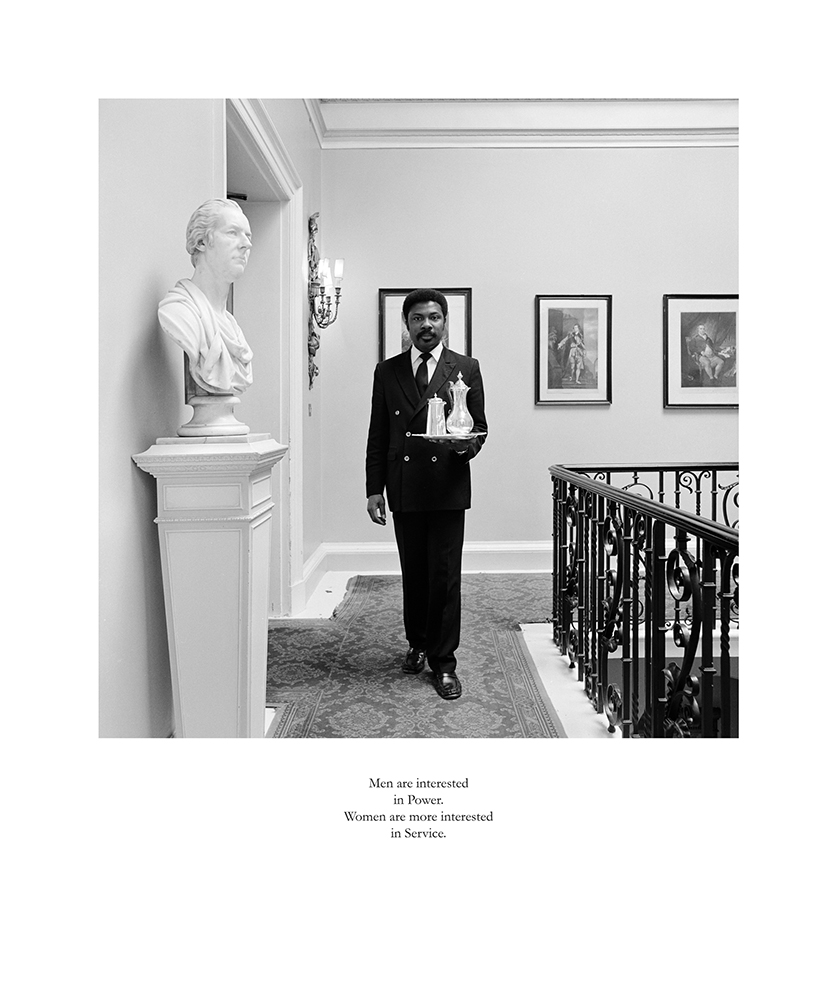
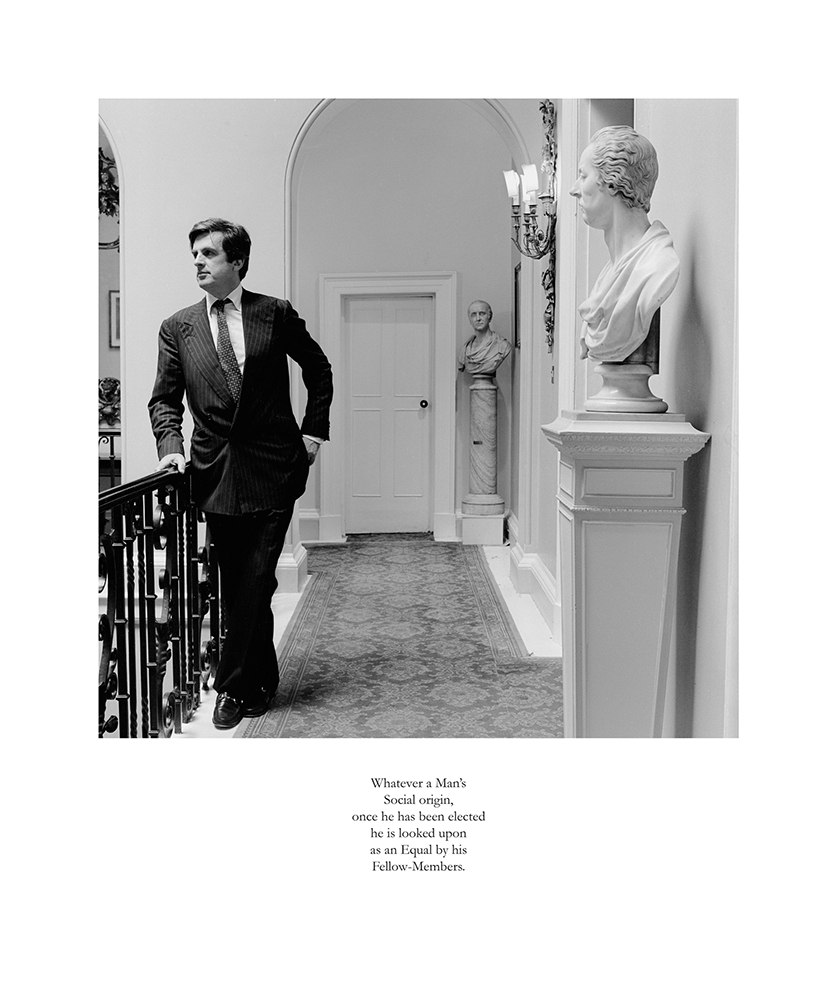
Karen Knorr is an American photographer, who, during the early 1980s, explored the exclusive gentlemen’s clubs of London. The images show rooms and often members in the mist of their activities here. The series is entitled Gentlemen, the images are surround by a white background and has text under the image. The text looks almost like a poem, but it is made up of snippets from parliamentary speeches and even from the news. This series explores issues surrounding wealth, patriarchy, privilege and power. The images represent the privilege of a few select members of society but also the entitlement of the clubs too. The series allows a glimpse at the traditions and values of the upper middle class. I also see these images looking at gender inequality. These clubs are exclusively for men, and at the time when these photographs were taken, women had only just been allowed to own property. It contrasts the experiments of the elite with those of all the women in the country. “Whilst women now gave full property rights, they still remain under-represented in key positions of governance and in financial and academic worlds. It is still a bouts club in which some women are honorary members” (Knorr).
This first image (see fig. 1), includes the caption, “Newspapers are no longer ironed. Coins no longer boiled. So far have standards fallen”. This shows the standards and values of these clubs, and how their standards differ from everyone else. Know uses humour to highlight the entitlement. The image shows a man sitting, he looks deep in though, with an almost sullen look on his face.
“Men are interested in Power. Women are more interested in Service”. This image (see fig. 2) shows a male servant, which is in contrast to the accompanying text. There are no women here, again this hints to the structure behind these clubs. Possibly even the staff are all male employees?
“Whatever a man’s Social origin, once he has been elected he is looked upon as an Equal by his Fellow-Members” (see fig. 3). This image shows that once a man is in this club, it is for life, he has made it. It is seen as a privilege and an achievement, his past doesn’t matter. Should they care about someones past? Maybe this is privilege in action, pasts can be overlooked as long as they have a Seat at the table.
Figures
Fig. 1. Knorr, K. Newspapers are [Photograph – Online] At: https://karenknorr.com/photography/gentlemen/ (Accessed on 13th of December 2019).
Fig. 2. Knorr, K. Men are interested [Photograph – Online] At: https://karenknorr.com/photography/gentlemen/ (Accessed on 13th of December 2019).
Fig. 3. Knorr, K. Whatever a Man’s [Photograph – Online] At: https://karenknorr.com/photography/gentlemen/ (Accessed on 13th of December 2019).
Bibliography
Knorr, K. Gentlemen 1981-1983. At: https://karenknorr.com/photography/gentlemen/(Accessed on 13th of December 2019).
New York Times. Karen Knorr’s “Gentlemen”. At: https://www.nytimes.com/slideshow/2016/10/20/t-magazine/art/karen-knorrs-gentlemen/s/karen-knorr-slide-FYWR.html/ (Accessed on 10th of December 2019).
O’Hagan, S (2016) Gentlemen by Karen Know review -eminently clubbable. At: https://www.theguardian.com/artanddesign/2016/oct/31/gentlemen-karen-knorr-london-clubs-mocking-rich-powerful (Accessed on 13th of December 2019).

 Georgina's Body of Work
1 thought on “Part Three – Showing Not Telling”