Coincidence and Street Photography
Jason Evans
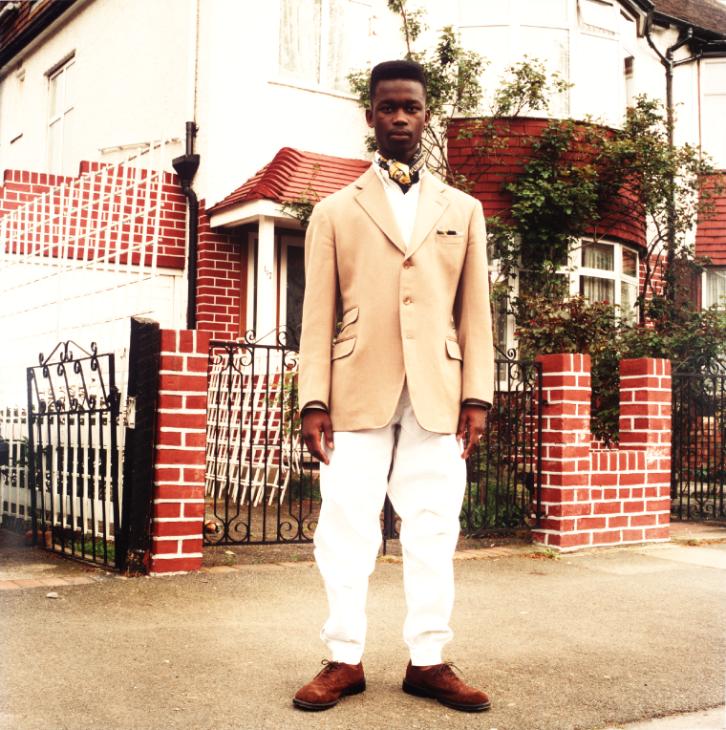
For his series Strictly Jason Evans collaborated with a stylist named Simon Foxton. Together they worked to create a series of images that delve into not only identity and multiculturalism in London but also into the political agendas that accompany it. Each image is taken on a London street, and features a black man dressed in rather distinctive clothing. Their expressions are emotionless and are stood in a stoic positions. The images are taken showing the subject full-length, and are usually taken from a lower position than the camera. It gives the men an advantage, they have an impressive presence. Evans has combined a form of documentary photography with fashion photography. When talking about the clothing, Evans stated “The syntax of the clothes was completely upside down. It was a new vision of Britain. We were trying to break down stereotypes” (Evans quoted in Williams). Evans brought in the fashion of the nineteenth century dandies, which contrasts the contemporary aspect of the men.
Bibliography
Tate. Jason Evans, Stylist Simon Foxton. At: https://www.tate.org.uk/art/artworks/evans-foxton-no-title-p11787 (Accessed on 4th of September 2019).
Williams, V (1998) Look at me. Fashion and Photography 1960 to the Present, exhibition catalogue. British Council: London, pp. 113-115.
Figures
Fig. 1. Evans, J (1991) [no title] [Photograph – Online]. At: https://www.tate.org.uk/art/artworks/evans-foxton-no-title-p11787 (Accessed on 4th of September 2019).
Eugene Atget
Eugene Atget started to photograph ‘old Paris’ in the late 1800s. He did this for around twenty years, he wanted to document the areas character. His aim was to document the streets and buildings before Paris was modernised. His images have a timeless feel. The are interesting and are taken using some interesting angles. They show a different Paris to what we se know. It allows the viewer to step into a part of history and imagine what it would have been like. His images provide a comprehensive study into pre-modernise Paris.
Bibliography
V&A. Eugene Atget. At: www.vam.ac.uk/content/articles/e/eugene-atget/ (Accessed on 5th of September 2019).
Exhibition – Henri Cartier Breeson: A Question of Colour – 2012 – Somerset House
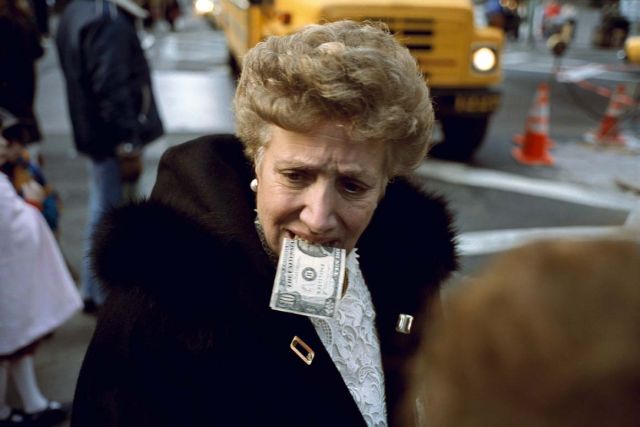
The Henri Cartier Bresson: A Question of Colour was an exhibition held at Somerset House in 2012. Despite being named after Cartier Bresson, the exhibition was dominated by other artists who were experimenting with their own decisive moments. The exhibition does however feature some of Cartier Bressons images which haven’t been exhibited in the UK before. Bresson had an unfavourable view on colour images he saw it as limited, but the images this exhibition are in colour. This image shows a women holding a one dollar bill in her mouth, obviously busy. It is a normal scene that happens to most people. But this scene may be a time of the past as debit and credit cards are becoming the norm.
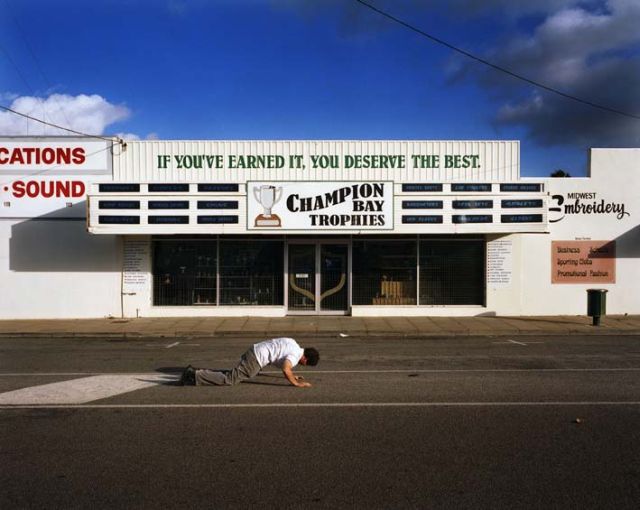
This next image shows a man vomiting the middle of the street. The sign above the shop behind him states, ‘If you’ve earned it, you deserve the best’, the shop is selling Trophies. This images shows a decisive moment, it is a good comparison between the man and the shops signage.
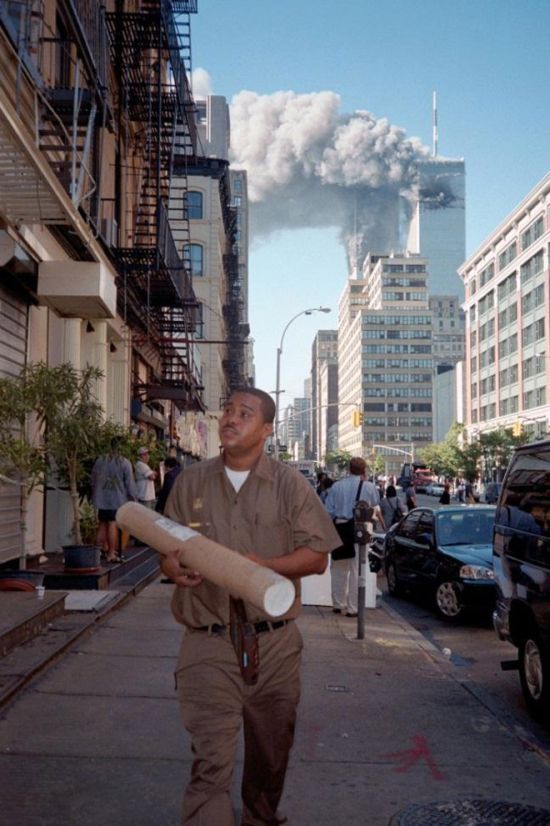
This last image was taken on 9/11. It shows the unfolding disaster in the background, but a courier is still working his rounds whilst it unfolds. It is a good image that shows how the world can carry on and remain obvious when something major is happening at the same time.
Bibliography
Phaidon. Henri Cartier-Bresson: A Question of Colour. At: https://uk.phaidon.com/agenda/photography/articles/2012/november/ot/henri-cartier-bresson-a-question-of-colour/ (Accessed on 5th of September 2019).
Somerset House. Cartier-Bresson: A Question of Colour. At: https://www.somersethouse.org.uk/whats-on/cartier-bresson-question-colour (Accessed on 5th of September 2019).
Figures
Fig. 1. Mermelstein, J (1992) Untitled (10 bill in mouth) [Photograph – Online] At: https://gerryco23.wordpress.com/2013/02/06/cartier-bresson-a-question-of-colour/ (Accessed on 5th o September 2019).
Fig. 2. Parke, T (2006) Man Vomiting [Photograph – Online] At: https://gerryco23.wordpress.com/2013/02/06/cartier-bresson-a-question-of-colour/ (Accessed on 5th o September 2019).
Fig. 3. Einzig, M (2001) New York [Photograph – Online] At: https://gerryco23.wordpress.com/2013/02/06/cartier-bresson-a-question-of-colour/ (Accessed on 5th o September 2019).
Martin Parr
Martin Paris images have always stood out. His images are quite recognisable for their bright colours teamed with a form of street photography which seems almost seems unrealistic and excessive. When talking about his images Parr stated, “With photography, I like to create fiction out of reality. I try and do this by taking society’s natural prejudice and giving this a twist” (Parr).
Bibliography
Parr, M. Martin Parr. At: https://www.magnumphotos.com/photographer/martin-parr/ (Accessed on 5th of September 2019).
Weski, T. Martin Parr. At: https://www.martinparr.com/introduction/ (Accessed on 5th of September 2019).
Walker Evans
Walker Evans has been involved in numerous projects, the majority address social issues and document various areas. He has documented places in New England, New Orleans, Pennsylvania, Tennessee and Alabama. He has taken images of buildings, coal mines, farming families and the effects of flooding. He then turned his attention to the American industrial landscape.
Bibliography
MoMA. Walker Evans. At: https://www.moma.org/artists/1777/ (Accessed on 5th of September 2019).

 Georgina's Body of Work