Tableaux
17th of June 2019
Research Point – Gregory Crewdson is a photographer who operates with strong directorial control in his image-making. His photographs function like film stills to the point where there is arguably not much ‘reality’ left in the scene. Do some research into Crewdson’s work and in your learning log or blog reflect on how his work relates to film and/or art.
For this research point I am required to look up the work of Gregory Crewdson, I have looked at his work very briefly on a previous course.
Crewdson is an American artist born in 1962. He is known for his staged images. He often uses American suburbs and develops a scene from there. The majority of his images do show what could be a real scene, but also a scene from a movie. He plans his images to the very last detail and is methodological about their production. His approach is similar to that a movie team would make; he has a huge production team, which help create the scene, and a lot also goes into the postproduction. It is like photography but on a grander stage. His images often have underlying messages, they show drama, tension, emotion, and the viewer if often left wondering what is real and what is not. One image I will look at is the Untitled (overturned Bus) (see fig. 1).
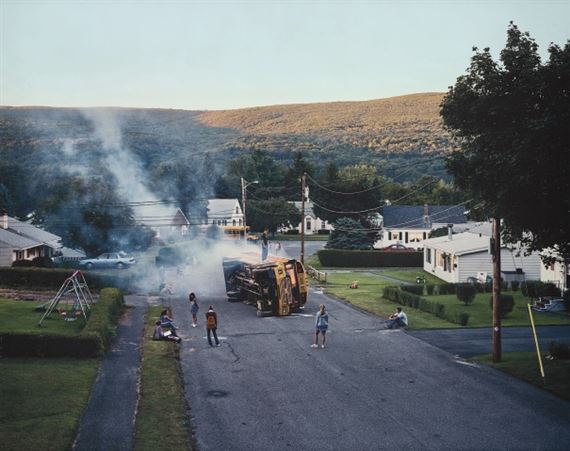
This images shows an overturned school bus on a typical suburban road. There is smoke coming from the bus, and there is debris around the road. There are children, probably from the bus standing and sitting around. But there is no emergency services, which could indicate that this event just happened. It looks like a scene you would see on the news. It looks real. It is quite thought-provoking and emotional. As it is showing what could possible happen, I imagine it would hit a nerve with some, especially if they have children travelling to school on a bus. It could almost be mistaken for a documentary photograph. It only seems to be children in the scene, there are no adults visible, I wonder if this is the hidden message, could it allude to problems children are facing or problems at school? This particular image is from his twilight series, in which he creates a simulation of twilight. This image doesn’t seem to fit the ‘twilight’ category, but it might just be my vision of twilight is different.
Crewdson to me isn’t a photographer in the traditional sense, more a cinematic artist. His skill is evident, and the detail and the production that goes into his images are massive. His images are demonstrating the challenge of photography and reality. He ‘makes’ the image, he doesn’t just take it. I believe his images relate to film and they both use a very similar technique. His images could be mistaken for film stills. But I think it also relates to art as he is creating a vision. These images represent his vision, the artist’s vision. They are extremely detailed with hidden meanings. They are beautiful in their own way, why shouldn’t they be seen as art?
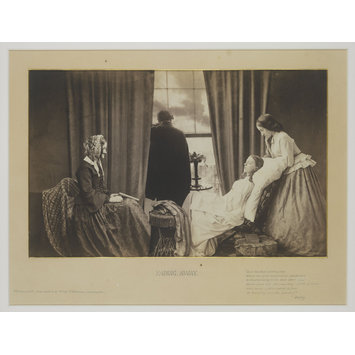
Tableaux is essentially staged photography. The photographer doesn’t just make the technical choices but also makes the choices regarding everything that is visible, from the positioning, to make-up, to clothes. “Rather than capturing the moment, artists make specific choices when staging their images” (Martinique). The actual term was used originally to describe paintings. It was Edouard Manet, who challenged the tableaux. His aim was to create a realistic image, so his decided to challenge the viewer. This developed and int he 1970s and the 1980s photographers started experimenting with tableaux. Henry Peach Robinson is one of the earliest tableaux photographer. His image created in 1858 (see fig. 2), shows a woman’s last living moments. She is surround by her family. Robinson created this image by combining five negatives.
Artists
Jeff Wall is a Canadian photographer who is known for his staged images. At university he decided to study art history, but ultimately decided that photography was his best option for visualising his conceptual art. Similar to Crewdson, Walls work looks like a film still, which is interesting as he himself describes his images as “cinematographic” (Wall, cited in O’Hagan). He gets his ideas from his own experiences, things he has seen or lived through. He revisualise what he saw, this process usually take Wall months to complete. The image titled Insomnia is a good example of tableaux (see fig. 3).
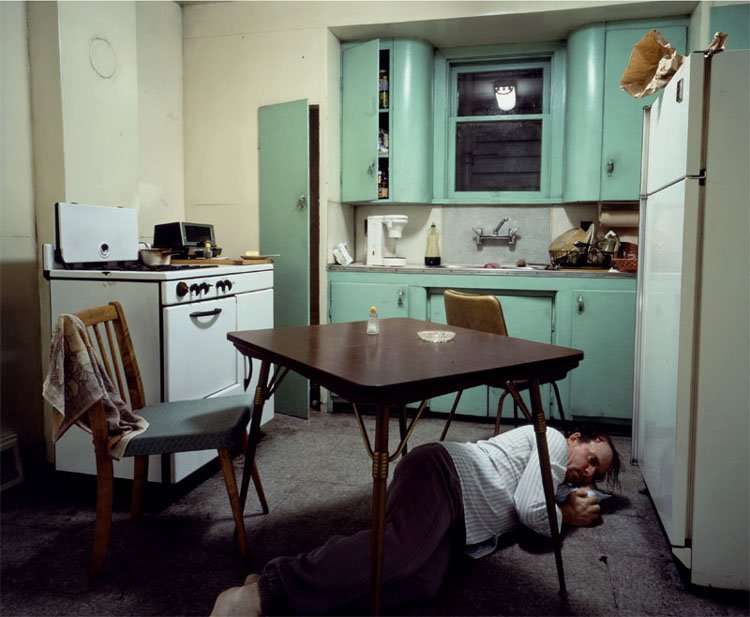
It is a staged seen to represent the mans struggle with insomnia, something many can relate to. The scene is set in a kitchen. It is old and worn. The chairs are matched and are scattered around. It is night time, and the kitchen light is very bright. The cupboard doors have been left open, this shows that the man may have searched through in desperation. The whole scene looks sterile. The actual man is positioned on the floor under the table. His expression is one of worry, he looks frantic and disturbed. He is in a form of feat also position, maybe looking for some kind of comfort. The image is quite busy, this could represent how busy the mans mind is, maybe this I why he can’t sleep. This image has a very psychological feel. It is very effective in portraying how wearing and destructive insomnia can be.
Philip-Lorca diCorcia creates images that combine fact and fiction. His combination of genuine places and real people is interesting especially since he puts them together when you necessarily won’t put them together. He is meticulous is his detail of the scene. Again, as with Crewdson and Wall, diCorcia is a cinematic artist. He does not tell us the narrative of his images, so it is mainly up to viewer interpretation. Andreas Gursky is known for his landscape images, especially for the price they reach at auction. Rhine II got a staggering $4.3 million at auction. Gursky himself has stated that he wants to “test the boundaries of photography” (Gursky, cited in Nayeri). He created an image by digital methods. He digitally created the whole scene.
Luc Delahaye was a documentary war photographer, but has now turned to making his art instead of documenting. He challenges the line between what is real and what is made up. When taking about his work and what tableaux is he stated, “It is something that has to have a certain dimension. Size is important: the physical rapport creates a relationship between you and the history of art. There is a harmony, a mystery, that takes you and resists you at the same time” (Delahaye, cited in Lennon). Hannah Starkey explores feminine agendas in her tableaux images. She explores theme like identity, race, class, politics and gender. She believes that her feminine aims only cam about because she is an ammo. Many of her images involve woman engaging in their daily routines.
Julia Fullerton-Batten is a German photographer who explores social agendas. Her series, Feral Children, 2015, looks at over a dozen cases of children who were feral. Fullerton-Batten re-enacted these cases by using young actors. Her images are names after the places and the dates where the children were found.
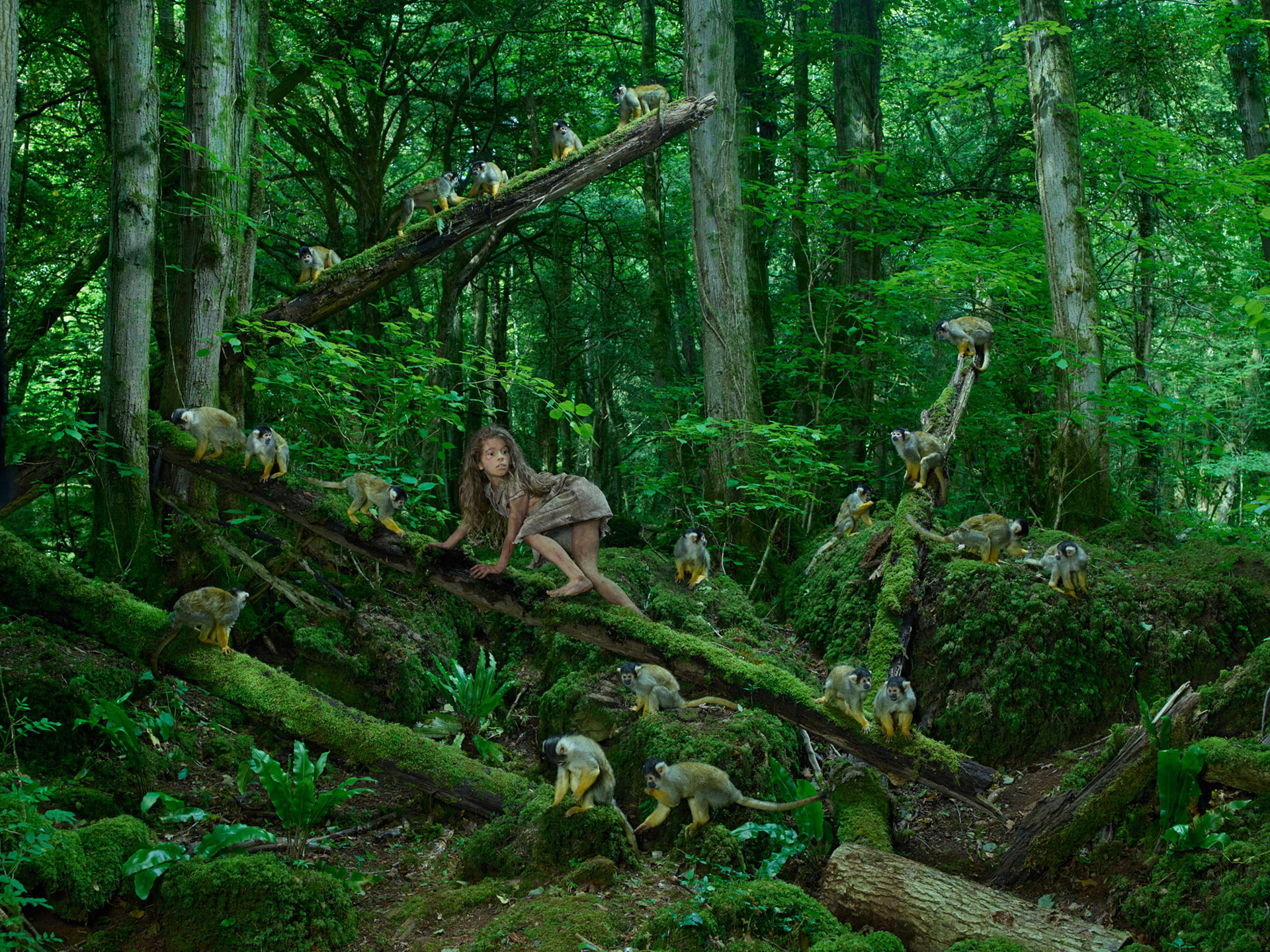
Marina Chapman, Columbia, 1959 (see fig. 4), shows an image of a young girl in the Colombian jungle. The geometric lines of the has fallen trees seem to add height and depth to the image. There are monkeys all over the image, this seems to imply that the girl grew up with them. The girl herself has dirty clothes on, her skin is grubby and her hair is long and unkept. She is walking up a fallen tree, exactly like a monkey would, another indication that she grew up with them. This image does look like a film still. It is an interesting take on reality and really makes the viewer think. We know it happened but can’t quite visualise it.
Tom Hunter is a British photographer who uses his local communities for his subjects.
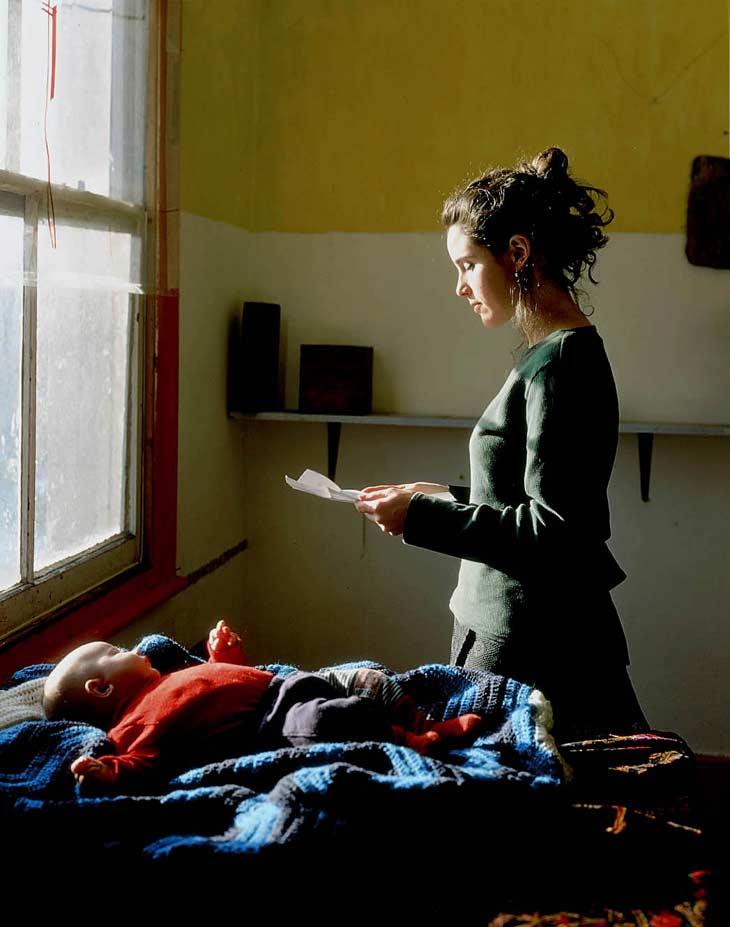
In Woman Reading Possession Order (see fig. 5), shows a women in Hackney reading a possession order. This is from a series of images that shows the squatters. This particular image shows the women as well as her baby. The walls are blank and bare, this indicates that they could be poor, this image evokes a sense of empathy and emotion, especially because she has a baby to think of.
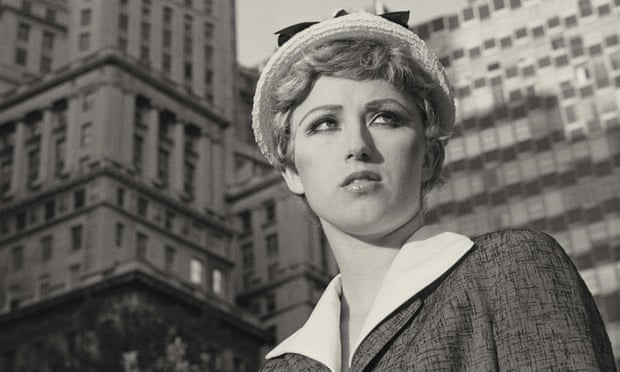
Cindy Sherman is another artist who creates staged images, but hers are mostly self-portraits. Sherman dress up in various costumes and styles from the past. She is able to create striking personalities. Her images are performative. She takes her ideas from popular culture. Her images truly look like old film stills. The image of a woman wearing classic clothing (see fig. 6). She is in a city, and is looking up to the right. This could be seen as a classical film image.
Tableaux photography is essentially staged photography, which is gaining in popularity, as it is the perfect platform for communicating an artists ideas. The images have been staged for a purpose, sometimes they are not immediately obvious. They have deeper meanings. The majority look like film still. It seems to combine a cinematic approach when photography. But what about magazine images or adverts, surely these would count as tableaux as they are staged with hidden meanings.
Bibliography
Artnet. Phillips London. Untitled (overturned Bus) At: www.artnet.com/artists/Gregory-Crewdson/untitled-overturned-bus-_hpTn6bSSjlp8v1XONjttVq2 (Accessed on 10th of June 2019).
Fullerton-Batten, J. (2015). Feral Children, 2015. At: https://www.juliafulleron-batten.com/projectmenu.php?catNo=1&gallNo=1 (Accessed on the 10th of June 2019).
Fullerton-Batten, J. Information. At: https://www.juliafullerton-batten.com/info.php (Accessed on 10th of June 2019).
Grundberg, A. (1981) ‘Photography View; Cindy Sherman: A playful and Political Post-Modernist. In: The New York Times [Online]. At: https://www.nytimes.com/1981/11/22/arts/photography-view-cindy-Sherman-a-playful-and-political-post-modernist.html (Accessed on 10th of June 2019).
Hunter, T. Info. At: www.tomhunter.org/info/ (Accessed on 10th of June 2019).
Lennon, P. (2004). ‘The Big Picture’ In: The Guardian. [Online]. At: https://www.theguardian.comartanddesign/2004/jan/31/photography (Accessed on 10th of June 2019).
Martinique, E. (2016). When Staged Photography Becomes Art. At: https://www.widewals.ch/staged-photography/ (Accessed on 10th of June 2019).
MOMA. Philip-Lorca diCorcia. At: https://www.moma.org/artists/7027/ (Accessed on 10th of June 2019).
Moody, R. (2002). Twilight: Photographs by Gregory Crewdson. New York: Abrams.
Nayeri, F. (2018). ‘Andreas Gursky is taking photos of things that do not exist’. In: The New York Times [Online]. At: https://www.nytimes.com/2018/01/29/arts/Andreas-Gursky-is-taking-photos-of-things-that-do-not-exist.html/ (Accessed on 10th of June 2019).
Nowness. (2017). Photographers in Focus: Gregory Crewdson. At: https://www.nowness.com/series/photographers-in-focus/Gregory-crewdson (Accessed on 10th of June 2019).
OCA. Beneath the Surface. At: weareoca.com/photography/beneath-the-surface (Accessed on the 10th of June 2019).
O’Hagan, S. (2015). Jeff Wall: “I’m haunted by the idea that any photography was all a big mistake”. At: https://www.theguardian.com/artanddesign/2015/nov/03/Jeff-Wall-photography-Marian-goodman-gallery-show (Accessed on 10th of June 2019).
O’Hagan, S. (2018). ‘Photographer Hannah Starkey: ‘I want to create a space for Women without judgement’’ In: The Guardian [Online] At: https://www.theguardian.com/artanddesign/2018/dec/08/Hannah-starkey-photographer-interview-space-for-women-Sean-ohagan/ (Accessed on 10th of June 2019).
Saatchi Gallery. Hannah Starkey. At: https://www.saatchigallery.com/artists/Hannah-starkey.htm/ (Accessed on 10th of June 2019).
Saatchi Gallery. Tom Hunter. At: https://www.saatchigallery.com/artists/Tom-hunter.htm/ (Accessed on 10th of June 2019).
Tate. Art term Tableau. At: https://www.tate.org.uk/art/art-terms/t/tableau/ (Accessed on 10th of June 2019).
Tate. Cindy Sherman. At: https://www.tate.org.uk/art/artists/Cindy-Sherman-1938/ (Accessed on 10th of June 2019).
Tate. Jeff Wall. At: https://www.tate.org.uk/art/artists/Jeff-Wall-2359 (Accessed on 10th of June 2019).
Tate. Luc Delahaye. At: https:www.tate.org.uk/art/artists/Luc-Delahaye-14771/ (Accessed on 10th of June 2019).
V&A. Fading Away. At: collections.vam.ac.uk/item/01410548/fading-away-photograph.-Robinson-Henry-peach/ (Accessed on 10th of June 2019).
V&A. Photograph by Gregory Crewdson. At: www.vam.acuk/content/article/p/Gregory-crewson/ (Accessed on 10th of June 2019).
Figures
Fig. 1. Crewdson, G. (2001-2002) Untitled (Overturned Bus) [Photograph – Online]. At: www.artnet.com/artists/Gregory-Crewdson/untitled-overturned-bus-_hpTn6bSSjlp8v1XONjttVq2 (Accessed on 10th of June 2019).
Fig. 2. Robinson, H. R. (1858). Fading [Photograph – Online]. At: http://collections.vam.ac.uk/item/O1410548/fading-away-photograph-robinson-henry-peach/ (Accessed on 10th of June 2019).
Fig. 3. Wall, J. (1994). Insomnia. [Photograph – Online]. At: https://www.tate.org.uk/whats-on/tate-modern/exhibition/jeff-wall/jeff-wall-room-guide/jeff-wall-room-guide-room-6 (Accessed on 10th of June 2019).
Fig. 4. Fullerton-Batten, J. (2015). Marin Chapman, Columbia, 1959 [Photograph – Online]. At: https://www.juliafullerton-batten.com/Gallery.php?catNo=1&gallNo=1&photoNo=4 (Accessed on 10th of June 2019).
Fig. 5. Hunter, T. (1998) Woman Reading Possession Order. [Photograph – Online]. At: https://www.saatchigallery.com/artists/artpages/Tom_hunter_woman.htm (Accessed on 10th of June 2019).
Fig. 6. Sherman, C. (1978). Untitled film still #21. [Photograph – Online]. At: https://www.theguardian.com/artanddesign/2018/jul/31/photographer-cindy-sherman-first-uk-retrospective (Accessed on 10th of June 2019).

 Georgina's Body of Work