Chance Encounters
Is there anything that you feel compelled to do at This point in your work but can’t figure out exactly how it will fit with your overall project? Talk to your tutor about it or write about it in your blog. It may be time for a change of direction.
Would you be comfortable using opportunistic encounters to create your art? In your view, has Calle been deceitful or intrusive in creating the works discussed here? How would you defend or criticise her approach?
I have been trying to develop my work and trying to see how I can include several themes successfully. I would like a female presence in the actual image, I want to present the inequality but I also want to contrast this with a strong female presence. I am just not sure how to do it. I am thinking my work will be a collage, so maybe I could add the image in. Due to the religious origins, I was thinking maybe adopting a triptych layout, with the main pilgrimage image in the centre and two others either side, one could be the female presence I am looking to include. I am just really not sure how to go about it just yet. I will try experimenting though.
Yes I would use opportunistic encounters in my work. Really this could be street photography, and even decisive moments. I would do it but only to an extent. I have looked at Sophie Calle’s work, and her project Take Care of Yourself, doesn’t seem intrusive to me. She is using her own experience and creating a work of art out of it. She has used the reactions and interpretations of other women for her work. I do not think this is wrong. But I do have an issue with her other works, Please Follow Me and The Hotel. These projects seem to be very intrusive. In Please Follow Me, Calle followed strangers in the street and photographed them, how is that not intrusive. Yes we are surrounded by cameras and CCTVs but to be photographed in the street without your consent and knowledge, is a bit intrusive. I am on the fence for me really as it could be just seen as street photography but where she loses my benefit of doubt is where she actively follows the people. This is wrong to me. How far would it go? What if someone complained to the police? The Hotel, for me definitely crossed the line between right and wrong. She actively went through other peoples possessions when she worked in a hotel, she made notes about what they had, where they slept, what they wrote in their diaries. She photographed their stuff to include in her project. I would not be happy if someone went through my possessions when I was staying at a hotel. You place your trust in the staff that your stuff and privacy is safe, she broke that. I cannot see how this is not intrusive and criminal. This definitely crosses the line. Another project of hers is entitled, The Address Book, Calle found a persons address book and proceeded to call up all the contact to inquire about it’s owner. She then published her findings in a newspaper.
There is another matter to consider, and that is her actions may be criminal in the UK. I spoke to a relative of mine who is a serving police officer. You are allowed to photograph people in the street, there is no law that says you can’t, but if they object, you should delete the images. But the time she posed as a chambermaid puts her on unsteady ground. When you stay in a hotel, your room becomes your home in the eyes of the law. As she was employed as a chambermaid, she was let into the rooms under the premise of being a chambermaid. When she does anything other than her chambermaid duties, in the law, it is counted as Trespass. Not only would she be in breach of her employment contract, she could also be prosecuted under the theft act. To be prosecuted under the theft act, she must have had commercial gain in any manner or form. So by exhibiting, selling, or publishing, she has gained from her photographs. If the victim is identifiable from the images or text, then it is definitely a criminal matter. Even if someone recognised their clothing, or their suitcase, they have been identified. The victims could also take her to County Court for invasion of privacy and seek damages.
Bibliography
Guggenheim. Sophie Calle. At: https://www.guggenheim.org/arts-curriculum/topic/sophie-calle (Accessed on 21st of August 2019).
Other Artists
Newsha Tavakolian
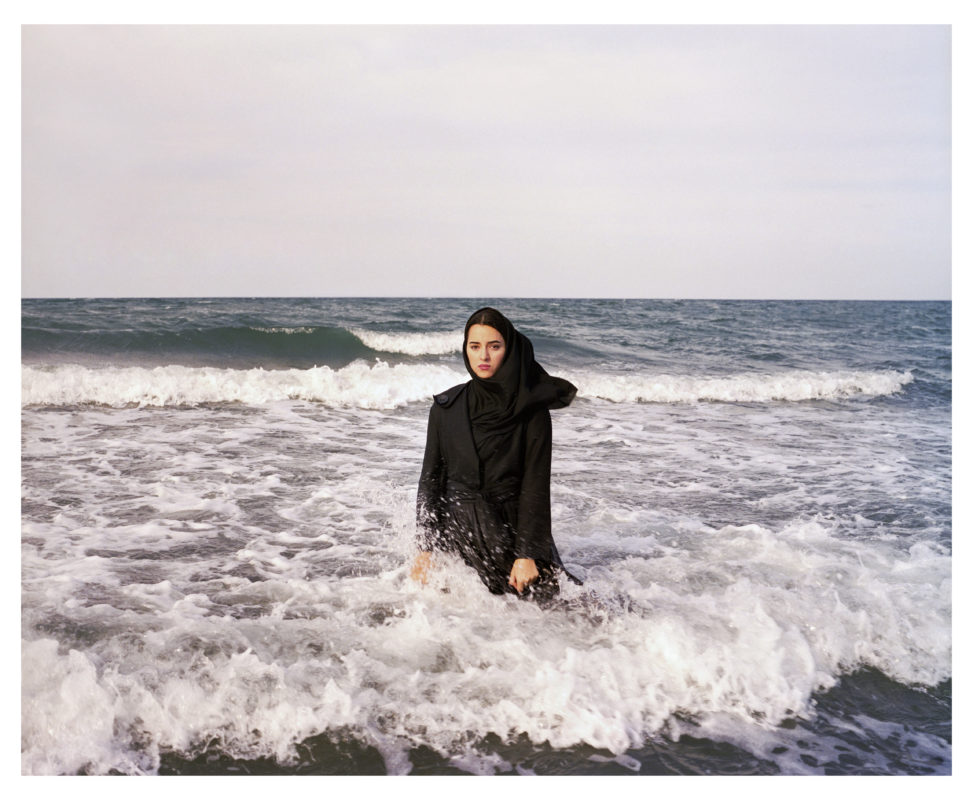
Another photographer who used chance to achieve their images was Newsha Tavakolian. For his series Listen, Tavakolian created a series of CD covers for fictitious female singers. For one image he got his sister to stand in the Caspian Sea (see fig. 1), he rushed to take the images and didn’t know how they would turn out. When reviewing the images, he found one which worked. His sister is looking directly to camera, and the waves are perfectly in time, probably a one in a hundred shot. But to Tavakolian it all fell into place. He took a chance taking the images as he didn’t known what they outcome would be.
Bibliography
British Journal of Photography (2016) Magnum Photographers discuss their decisive moment. At: https://www.bjp-online.com/2016/06/magnum-photographers-discuss-their-decisive-moment/ (Accessed on 4th of September 2019).
Figures
Fig. 1. Tavakolian, N (2011) Imaginary CD Cover for Sahar. [Photograph – Online] At: https://www.bjp-online.com/2016/06/magnum-photographers-discuss-their-decisive-moment/ (Accessed on 4th of September 2019).
Chris Coekin
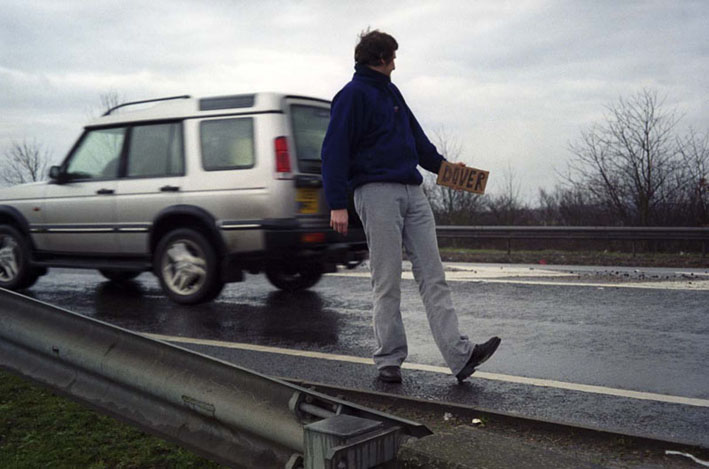
Chris Coekin often looks at his own personal experiences for inspiration. He collaborates with other artists, and often uses archived images, texts and sometimes audio. His series The Hitcher confronts the image of dangerous strangers that is spread by the media. But his experiences shows the opposite where strangers were kind and helped him. His project is spilt into three sections. The first looks at other hitchhikers. His images show the spontaneous nature of their encounter. His images are change encounters. This image shows a man hitchhiking (see fig. 1), the car passing is blurry, showing it is driving past and not stopping. The man holding a sign, looks as it passes. It is real, almost a decisive moment.
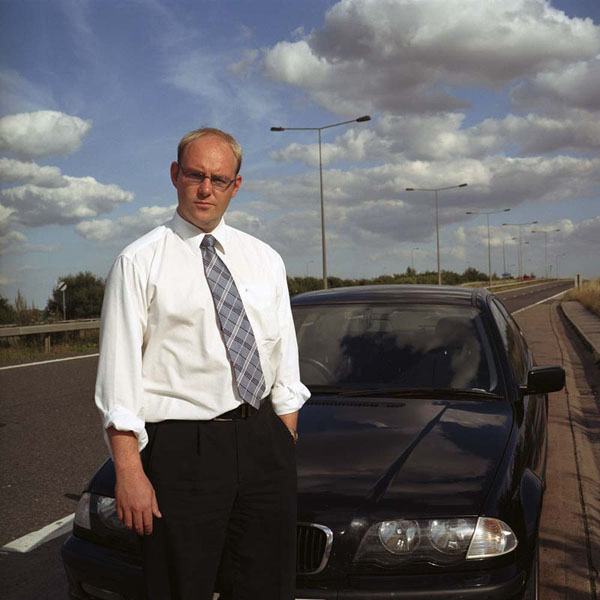
The second series looks at the people who picked him up. He got them to pose outside their car. He is comparing the ‘stranger danger’ with his own experiences of friendly helpful strangers (see fig. 2).
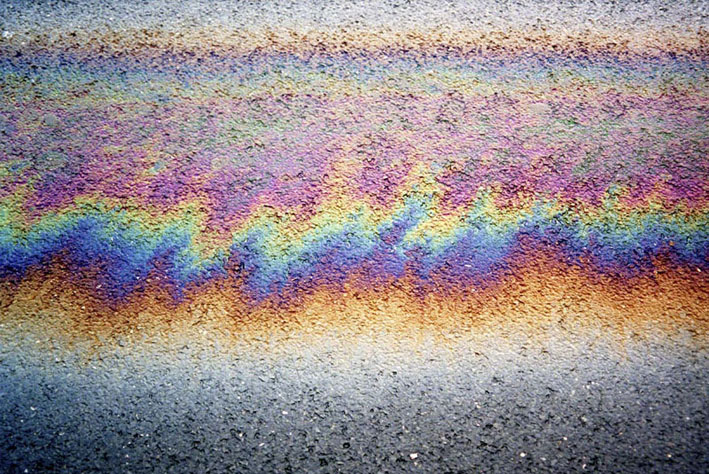
The third part shows things that a hitchhiker might see by the side of their road. Things like banana skins, a dead rabbit, a portable DVD player, an oil slick, and rubbish from McDonald’s make an appearance. The image showing an oil slick (see fig. 3), is a common sight on the road. But drivers might not notice it, but hikers will. They are simple images but explore his own experience with strangers and manages to combat the view that all strangers are to be feared.
Bibliography
Coekin, C. Biography. At: www.chriscoekin.com/index.php?/about-this-site/ (Accessed on 5th of September 2019).
Telegraph. Chris Coekin: The Hitcher. At: https://www.telegraph.co.uk/culture/3675360/chris-coekin-the-Hitcher.html?image=3 (Accessed on 5th of September 2019).
Figures
Fig. 1. Coekin, C. Untitled [Photograph – Online]. At: www.chriscoekin.com/index.php?/pngoing/the-hitcher-series-1/ (Accessed on 5th of September 2019).
Fig. 2. Coekin, C. Untitled [Photograph – Online] At: www.chriscoekin.com/index.php?/ongoing/the-hitcher-series-2/ (Accessed on 5th of September 2019).
Fig. 3. Coekin, C. Untitled [Photograph – Online]. At: www.chriscoekin.com/index.php?/ongoing/the-hitcher-series-3/ (Accessed on 5th of September 2019).
Gillian Wearing
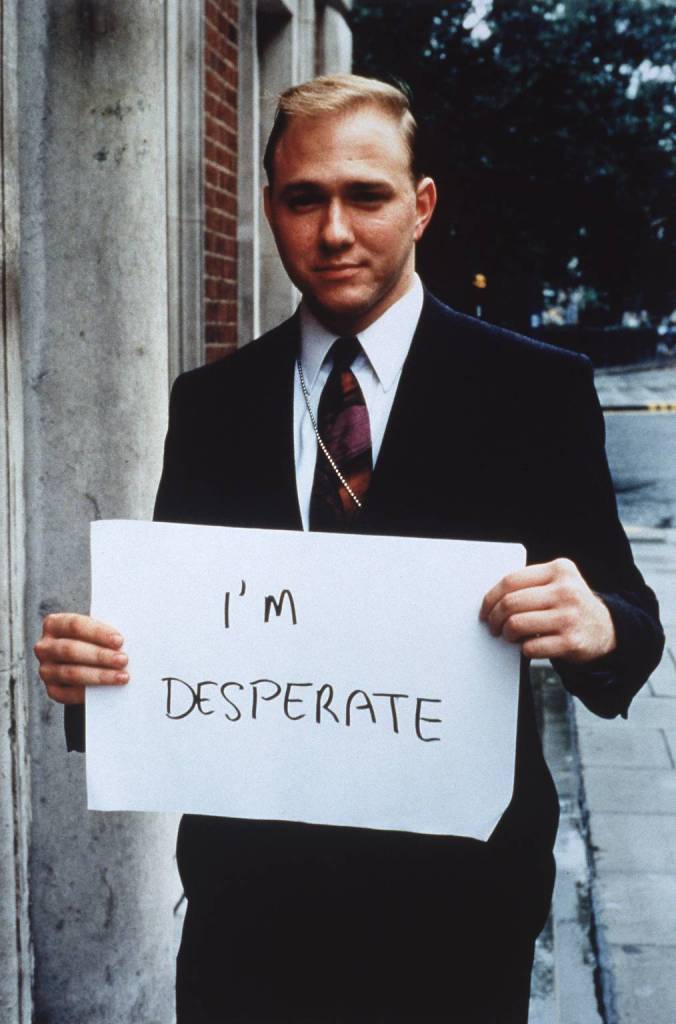
Gillian Wearing created a series entitled Signs. Wearing took to South London, and asked people to write how they were feeling down on a piece of paper. She then got them to hold their sign whilst she photographed them. It is a fascinating series that actually documented the social and economic times during the 1990s. The image that shows a man holding a sign that reads “I’m desperate” (see fig 1), is incredibly emotional and telling of the experiences of uncertainty and difficulty that people went through. Wearing stated that the man was ‘shocked’ that he wrote that, he had his picture taken and then angrily left. He could have been angry because it revealed how he truly felt and was angry at himself for letting his mask fall.
Bibliography
Montagu, J (2001) Gillian Wearing CBE. At: https://www.tate.org.uk/art/artworks/wearing-im-desperate-p78348 (Accessed on 5th of September 2019).
Figures
Fig. 1. Wearing, G (1992-1993) ‘I’m desperate’ [Photograph – Online]. At: https://www.tate.org.uk/art/artworks/Wearing-im-desperate-p78348 (Accessed on 5th of September 2019).
 Georgina's Body of Work