Found Photography
Here is an audio interview with Schmid: www.lensculture.com/schmid_interview.html/
I have looked into Joachim Schmids work before on a previous course. Here is a part of my research into his work.
Joachim Schmid is a German artist born in 1955. He is best known for his appropriation of other people’s images to for us in his own work. He use to find his images in flea markets or discarded on the streets but now he uses the internet. He has published over ninety books, and explores the relationship between us and photography.
Sharon Boothroyd conducted an interview with Schmid. Schmid admits he was always curious about snapshots; he sees them as a cultural practice. He saw recurring patterns throughout the images he found. He doesn’t like the word collecting he prefer gathering. He does admit his method can be tedious, but over time he sees inspiration when looking through the images. Schmid has tried two methods of presenting his work, in book form and as a digital slideshow. He stated that slideshows only hold the viewers attention for a very short time, whilst with a book, people take their time. Before the internet, Schmid faced limitations with his work, but now with the internet there is an unlimited supply of images; he finds technology more suitable for his work. When asked by Boothroyd why people take the same photo, he stated because ‘they work’. He believes a problem might occur with the overproduction if photographers, as their are huge limitations on artists and everyone has to fight for their rights.
I watched an interview between Arthur Ou and Joachim Schmid. Despite not actually taking any photograph Schmid sees himself more like a photographer as they go through ‘public spaces’ searching for a photograph. He sees his method as a form of archaeological research. Schmid is very selective in the images he chooses.
In his series Pictures from the Street (1982-2012), Schmid collected discarded images off of the street. By collecting the unwanted images and presenting them in a similar fashion as a museum does, you get a much clearer view on what photography is.
In Photographic Garbage Survey Project (1996-1997) Schmid mapped discarded images in seven cities across the world. He made a statistical analysis, so it wasn’t just a matter of collecting images. He found:
91 objects over 9 days in Paris,
83 objects over 8 days in São Paulo,
43 objects over 6 days in Berlin,
28 objects over 4 days in Rotterdam,
28 objects over 6 days in San Francisco,
23 objects over 5 days, in Vigo, Spain, and
23 objects over 4 days, in Zurich. He also found that:
Rotterdam had 68% of intact photographs,
Vigo had 83% of ripped up photographs,
Zurich had 50% of photobooth of photobooth photography,
San Francisco had 36% of Polaroid’s, and
Paris had 36% of ID photographs.
He decided to exhibit the original images for this series as it gave a more authentic feel as you can see how the images have been destroyed for example many were torn. By exhibiting these discarded images, it does what a museum does but goes against the norm, which a Schmid believes create a nice balance between the two.
Other People’s Photographs (2008-2011) features ninety six images which Schmid organised by topic. He wanted to show how photography has changed. This work demonstrates the patterns in people photography and how similar they are. Schmid used the internet for this project which provide an unlimited supply.
One Day in May (2014) is a series that documented fifty shooting in America on one day in May. Schmid organised these so they featured east to west. This series was produced into a book which featured a map of the US with the shooting marked on it.
In 1990, Schmid created a series entitled Used Photographs, which is where he formed the Institue for the Reprocessing of Used Photographs. He placed adverts in newspapers stating the dangers of old photographs and how he could take them off your hands for free. People believed him, he used these photographs that people sent him for this project.
Schmid sees himself as an artist as he doesn’t believe there is any other way to describe himself. I agree with this as he can’t be called a photographer as he doesn’t take photographs, merely uses them.
Bibliography
Boothroyd, S (2013) An Interview with Joachim Schmid. At: https://weareoca.cpm/subject/photography/an-interview-with-Joachim-Schmid/> (Accessed on 10th of January 2018).
Hillman Photography Initiative Carnegie Museum of Art. Photography as Urban Archaeology: The Practice of Joachim Schmid. At: www.nowseethis.org/invisiblephoto/posts/678/essay/13n/(Accessed on 10th of January 2018).
Stewart, G (2018) Research. At: https://georginasocalearninglogdigitalimageandculture.wordpress.com/2018/03/02/research-4/ (Accessed on 29th of October 2019).
At the time of writing submissions are still open but you should be able to see the finished results on the blog: https://www.thefrankalbum.wordpress.com/
What are you thoughts about The Frank Album? Are there any ethical issues here? To what extent is a photograph album like Frank’s private? Make some notes in your learning log/blog.
This project by Alec Soth is interesting. But like Calle, there are some issues. Soth found the images that feature in the album, these images belong to someone, someone who may have lost them and now they are being published in a artists projects. Do the images really belong to Soth? Would this be covered under appropriation or found photography. The project is quite unique, as when you buy a copy, you are given a blank album, with the photographs separate, you also get text in either English or Japanese. This gives you a chance to arrange the album how you want. You get to make up this travellers journey. It is engaging and interactive for the viewer and will be unique and everyone who does it will produce a very different album. But I am not sure about using someone else’s images. It comes under the same problem with appropriated images, is this theft? The artists is using and profiting from someone else’s images, he is intent on keeping them. This is one reason I am dubious with using someone else’s images as they could be copyrighted or the person could go to the police, as people have done to artists in the past.
Have you ever made a ‘mistake’ that has led you in a new direction? Has reading this account of Paul Graham’s work made you less likely to discard ‘mistakes’ or more likely to investigate their potential? If something like this happens to you in the future, here are some questions to consider:
- Has something gone wrong that you don’t know how to recover from?
- How might you re-frame what happened?
- How could it lead to something more exciting?
- What might your ‘mistake’ be telling you?
My body of work uses similar techniques to Graham’s work. I am using images that people would discard as mistakes. My images are out-of-focus, underexposed, and overexposed. But they are like this on purpose as I am using this to show the inequality in landscape photography. If I wasn’t, I would usually discard this type of image. But theoretically yes, I could keep them and develop it into a project. It could lead to something completely new. You never know unless you try. Usually I would say my mistakes were telling me that I messed up taking a picture, for example the settings were wrong or the camera moved.
The Day Nobody Died series represents a profound concept of the engaged, professional witness. See: www.choppedliver.info/the-day-nobody-died/
The Day Nobody Died is a project by Adam Broomberg and Oliver Chanarin. In 2008, they travelled with this army to Afghanistan, they took a roll of photographic paper. They were in the middle of a war zone, instead of capturing events with their cameras, they unrolled part of the photographic paper and exposed it for only 20 seconds. To do this the artists lied to the Ministry of Defence in order to get access, they told them that they were photojournalists not artists. In the artists opinion, the MOD were worried about what an artist could create about the war rather than the documentation of a photojournalist. This series is a good example of conceptual photography. Without the background of what the artists did to get their final image, the image doesn’t mean a lot to a viewer, the artists want the viewers interpretations to come to mind. There is nothing to go on, no figures, no landscapes, nothing. It is just paper that have various exposures on it. It is the story behind it, that gives it meaning. I think it is a creative way of showing war photography. As a lot of war images are very similar, they document. This goes that step further, the actual paper has been in the war zone, it has been exposed to it, that’s it’s story. But I do think it is necessary to see the artists aim to really be able to look and get the image. It makes you wonder what was going on at the particular time. It is thought provoking. The artists believed the projects home in a gallery. But when they showed a sample of the project to the editor of the Guardian newspaper, he thought that they were ‘taking the piss’. This comes down to viewer interpretation and expectations. Yes it is very different from the usually war photographs we see, but why does that make Broomberg and Chanarin’s work less valid.
The artists also created a short film to accompany the work. This film follows the box that carried the photographic paper in. It starts off in London, travelling in a car through the streets then n the airport. It shows it being transported by plane, by car, in trucks, in tanks, and in helicopters. It also shows it being carried around by various soldiers in Afghanistan. I believe this video gives context, as it shows the journey they have been on. But your attention is not on the artists, or on the actual paper, it is on the cardboard box. It has it’s function, to carry the paper, but other than that it is a banal object, but centerstage in the film.
Broomberg, A. & O. Chanarin. (2008). The Day Nobody Died. At: http://www.broombergchanarin.com/the-day-nobody-died-1-1 (Accessed on 27th of August 2019).
Broomberg, A & O. Chanarin. (2008). The Day Nobody Died. At: https://www.youtube.com/watch?v=HHLtElcCkZ8&t=585s (Accessed on 27th of August 2019).
Source. What is Conceptual Photography? At: www.source.ie/feature/what_is_conceptual.html (Accessed on 12th of June 2019).
Are the projects you’ve been reading about a case of ‘The Emperor’s New Clothes’? Or are the artists using their creativity to make art out of worst-case scenarios? Are they cheating?
Personally I would see this as an artist being creative. If you just took some basic images, yes they may be good but they are going to be very similar to someone elses. These artists have gone beyond the norm and have challenged and explored their topic and have produced some very creative images. I do not think they are cheating, they are being creative, they have successfully produced a unique project. This is creativity in their art.
See this video: http://daylightbooks.org/podcast/October2010 How well did the seven-year-old do?
This project was a collaboration between Alec Soth and his daughter Carmen. Carmen Soth photographed the streets of Brighton. It is interesting to see the world from her prespective. You can see the camera angle is lower, obviously due to her height. But unless you knew that they were taken by a seven year old, I doubt the majority of people would know. I think she did very well. In the exhibition the images are among newspaper headlines, reinforcing the localities of the project.
You can make connections between the headlines and the text. It allows the viewer to interact and come to their own conclusions. There is even a handwritten note form Carmen, written in crayon “To people i Really did take all these pictures…From Carmen Soth”. I find it quite sweet, it contrasts the street photography, which could be seen as being taken by an artists with the fact that she is still a child. The images show a different perspective through the eyes of a child, which is very different from the usual street photography we see.
Bibliography
Photoworks. Brighton Picture Hunt. At: https://photoworks.org.uk/news/brighton-picture-hunt/#close-no (Accessed on 29th of October 2019).
Other Artists
Weronika Gesicka
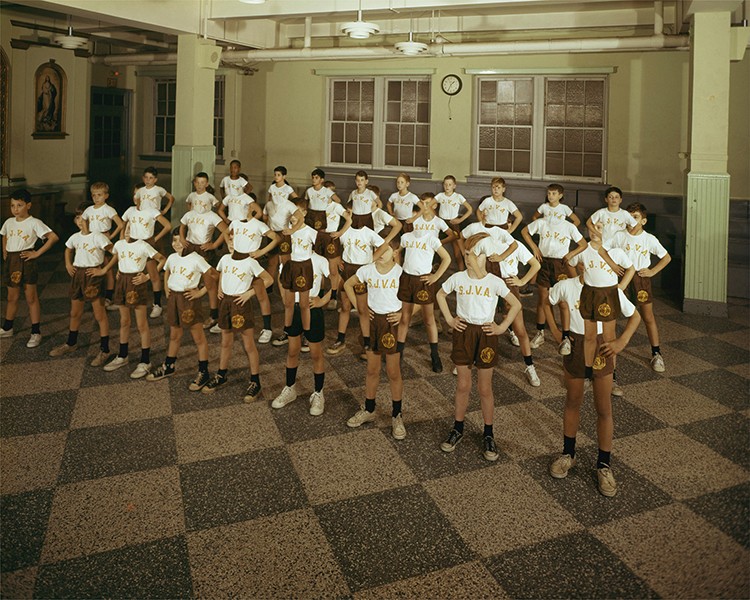
In her series Traces Weonika Gesicka explores stock images. She recreates classical images from 1950s and 1960s American life. Gesickas images looks at how truthful can they be. She also explores how memories can be altered. “There is no certainty of the past if the present can change it” (Pacciardi (2018). (see fig. 1)
Bibliography
Pacciardi, G (2018) Traces is a Project by the Polish artist Weronika Gesicka Who questions about the truthfulness of the stock images. At: https://www.collater.al/en/traces-weronika-gesicka/ (Accessed on 4th of September 2019).
Figures
Gesicka, W. Untitled #5 [Photograph – Online]. At: weronikagesicka.com/en/gallery/5/ (Accessed on 4th of September 2019).
 Georgina's Body of Work