Muhammad Sadiq Bey was one of the first photographer to photograph the pilgrimage to Mecca. Bey took images using a wet-plate collodion camera, which used glass plate negatives. His photographs include images of the exterior and interiors of both Medina and Mecca. He also took a stunning panoramic image of the holy mosque at Mecca. His images are taken from an insider perspective which does give them value. He is showing the area, more than the actual pilgrims, but he is a pilgrim, so his images are actually documenting his journey. We get an insider view of undertaking the Hajj, which is interesting in an anthropological viewpoint but also the images are aesthetically interesting. His images were inspiring as they followed a pilgrimage, which is what I want to do (see figures).
Pilgrimages aren’t always a religious journey. Many artists have used the premise for exploring their spiritual journey. One such artist, is Annie Leibovitz, with her series entitled Pilgrimage. Leibovitz created this series by photographing places with meaning to her, it allowed her travel without an agenda; it also became her first primarily digital series. None of her images in this series contain people, but they do contains traces of life. She explored places such as Niagara Falls (see fig. 1) and Georgia O’Keeffe’s house (see fig. 2). She also photographed objects like Sigmund Freud’s couch (see fig. 3). The results are a truly personal project which show portraits of the past, without featuring people. I found her images interesting especially the museum pieces, as the light she utilises was very atmospheric. But I did find some of the images more like snapshots that any one could take, for example her image of Niagara Falls; it was as if no thought had gone into the image process. The series doesn’t feel complete, it doesn’t feel like there is a consistent narrative. Whilst I understand it document her journey, I think it would be beneficial to have more consistency. I found a copy of the book, the major problem is that the images and text don’t often match up, which makes it difficult to fully engage with the project.
(Fig. 1. Niagra Falls (2009))
(Fig. 2. Door in abode wall at Georgia O’Keeffe’s home (2011))
Karen Miranda-Rivadeneira is a Photography who looks at identity, memory, feminity, and memories in particular in nature. Her landscapes are engaging and though provoking, in her series MEDA, her images show the body embedded in the landscape. The female body and nature unite and become one. She is using the body as a metaphor for knowledge. It is a symbol for knowledge and being at one the land. She is also comparing the female body and the land as nature is not the first land we live in, the body is. They share similarities. Stardust Woman(see fig. 1)reminds me of a far away galaxy. The swirls of the rock teamed with the ‘stardust’, looks like something cosmic.
(Fig. 1. Stardust Woman (2018-2019))
The image from the series I like the most shows a women tangled among the branches. Th woman looks like an extension of the tree (see fig. 2). Her limbs blend with the limbs of the tree.
(Fig. 2. Untitled (2018-2019))
In her series Rowing Chants, Rivadeneira uses it as a chance to document her personal journey in Toas. This series only contains seven images, and for Rivadeneira it is her thank you to nature. Each image is presented with two images and with a poem. One image is of nature and the other is a female body. La Medida (see fig. 3)shows trees branches reaching to the sky, in the other image is a woman reaching her arms up to the sky. One line of the accompanying text states, “the outline of my body is always the inline of nature” (Miranda-Rivadeneira (2019)).
(Fig. 3. La Medida)
The next images is entitled 13:42 (see fig. 4), and shows a textured wall next to the back of a woman. Her images are comparing the body to nature.
(Fig. 4. 13:42 (2019))
The contrast between nature and the female body is a strong one. The artist is saying that this is how close she feels to nature, how we and nature can become one.
Catherine Opie is an American photographer who investigates issues surrounding feminism, whilst utilising portraiture and landscape photography. Opie’s series, As long as they are wild, documents her exploration of Yosemite National Park as a feminist. The series is a mixture of in focus or blurry images. There is no text, so the images are hard to pin point, as there is no narrative. There are purely landscapes, there are no people. At face value, you could look at her images are think they were taken by someone on holiday, someone who got the composure wrong, who didn’t focus them, basically images that would be binned when editing. But when you look deeper, you can see her reasoning. Her images, in particular Untitled #2 (see fig 1), reminds me of Ansel Adam’s Mirror Lake(see fig. 2). Whereas Adams images are sharp, in focus and meticulously detailed, Opies is blurry. Adam’s image is through a male gaze, it is perfect. It is almost as if she is doing the exact opposite, as if her images could never be taken through a male gaze, as they are not perfect. They are through a female gaze, fighting against the traditions.
(Fig. 1. Untitled #2 (2015))
(Fig. 2. Mirror Lake (1925))
Her images hold an uncertainty, there is nothing to go on, they show vulnerability and even loss. It strikes as she is taking a stand against the traditions of landscape photography, but also shows almost her loss of identity. I like her series as they hold a deeper more complex meaning, one which has been influential in my body of work.
This is the effect I want in my Body of Work images. I want the uncertainly, I want the images to show an uneven stance, like something is wrong. I think this will be an effect way of portraying a problem. Whilst I am investigating the inequality in landscape photography, I believe this Technique can show something is not quite right and make the reader think.
I have decided to keep a journal as I complete this course. I will transcribe and update as I write it. I will aim to do a new entry for each location.
July 2019
1st assignment. Preliminary photo shot. One location about 30 images.
Aim:
different angles
different exposures
different focuses
different features
different symbols
Symbolise female gaze?
not perfect images
not picturesque
show unequal footing
difficulties
hard to be seen (noticed as a women in a male dominated world)
Not only through Female gaze but also to feature in the image but not portraits.
What does feminism mean for me:
Equality for all.
Not just for women but for men also everyone should be treated equally and have to same opportunities.
In a society where we are told how to look, how to dress, how to act, how to live and how to be a woman. Where w need to be strong but feminine at the same time.
What does a strong woman mean to me?
Not always a positive. Terms like strong, fiesty, and sassy, in negative terms are usually given by men who do not like it when women speak and act for them selfs.
To me a strong woman is:
Independant
Not afraid to show her intelligence
Respectful
Balanced
Is not defined by others
Humble
Grounded
Isn’t afraid of her own feelings
Fighters – stands up for what she believes in
Doesn’t listen to expectations
Unapologetic about who she is
Who are strong women:
Michelle Obama – Lawyer, Former 1st Lady, Writer
Oprah – Host & Philanthropist
Sarah Silverman – Comic – address several issues like sexism and religion.
Ellen DeGeneres – Comic, Host, Activist
Danica Patrick – Retired Racing Driver
Maya Angelou – Poet & Civil Rights Activist
Marie Curie – Physicist
Amelia Earhart – Aviator
Emmeline Pankhurst – Campaigned for votes for women
At the beginning of Part One, we discussed genre as something that creates expectation and, arguably, provides a frame of reference for the viewer. But if the boundaries between genres are blurred, how useful is genre as a concept? Or does it’s usefulness lie in providing something to subvert or react against? Now that you’ve reached the end of this part of the course, spend some time reflecting on the significance of genre in the creation and consumption of photography. You may find it helpful to refer to David Bate’s helpful summary, referred to at the start of Part One.
“A Genre helps to organise and structure particular types of meaning” (Bate, p. 4). Organising by genre is helpful in analysing an image, it helps to understand its path, it’s context and even its narrative. Being able to recognise a genre is useful in many ways. But the problem is that genres are flexible, they mould and evolve over time so become difficult to categorically label. According to Bates, genres each have a function, by noting these we can analyse and understand it, “different genres, have different functions” (Bate, p. 5). To me, genres are important for labelling and analysing the image, not so much when creating it. You don’t really start out to make an image and think ‘what genre should I make this into’, you have an idea and produce, it then fits into a genre or several. Genres are so diverse, and blend into each other, sometimes they are difficult to recognise.
Bibliography
Bate, D. (2016). Photography: The Key Concepts (2nd edn) London: Bloomsbury Academic, pp. 4-7.
Source photographic journal made three films asking photographers, artists. Curators and editors for their response to the question ‘What is Conceptual Photography?’ No-one had any clear-cut answers but there are some interesting opinions being discussed, like alternative views to straight photojournalism by Adam Broomberg and Oliver Chanarin. John Hilliard talks about being known as a conceptual artist in the 1960s and 70s. Hilliard is still taking photographs today. Watch the video and then write a paragraph explaining what you understand by the term ‘Conceptual Photography’. Provide some examples of recent work that you believe falls into this category.
Born in 1887, Marcel Duchamp was a French photographer, who shaped and lead the Dada movement. This movement challenges the belief system surrounding art. What is art, how it should be created. Duchamp was a painter but changed his direction as he wanted to experiment with ideas. In 1917, Duchamp put forward a piece of art into the New York Society of Independent Artists, in the form of a urinal, which he signed ‘R. Mutt’. He began using objects themselves as pieces of art. He choose readily available items and declared they were art. In his series of ‘Readymades’, Duchamp aim was for “an ordinary object [could be] elevated to the dignity of a work of art by the mere choice of an artist” (MOMA). This practice does raise some good points, why can’t an object be art, when designated by an artist. Art is about vision, the vision of the artists, so what does it matter is the artists is showing an mundane item. Duchamps work contributed to the beginnings of Conceptual art.
The videos from Source were interesting. They started talking about the actual term, conceptual. According to critic, Lucy Sautter, it should perhaps be called ‘idea art’ as this would be more fitting. The artists using the conceptual genre don’t care about the long established traditions in photography. Context is also key in conceptual photography as it can dramatically change the meaning, as not everyone will understand the underlying messages. Sautter goes on to say that conceptual art is anti; anti subjective, anti personal and anti emotional. Suzanne Mooney created a piece of work entitled Make love to the Camera, in which she combined diagrams from old photographic books. Her aim was to explore a love hate relationship. Critic Sean O’Hagan conceptual art is open to abusive criticism. Oliver Chaharin doesn’t believe in conceptual art, he believes that “all photography is conceptual…All photography is an abstraction of reality” (Chaharin, cited in Source). Chaharin and Adam Broomberg created a project together which involved travelling with the army to Afghanistan with a roll of photographic paper, unrolling it and exposing it for only 20 second. The faced difficulties, as if they said they were artists they wouldn’t have been allowed to do this, so they said they were photojournalist. When they tried to advertise their work, the editor of the Guardian newspaper thought they were joking (Source).
After watching the videos from Source, I think conceptual photography is quite an open genre. In the art world it took a firm hold during the 1960s and the 1970s. In which the artists looked outside of the traditional photography value, they experimented and created. Many are staged images, which represent the artists vision, an idea if you like. But all photography is born from an idea surely? Conceptual photography seems like a free for all, it allows for expression, experimentation, ideas could be completely out there or quite simple. The true definition is hard to pin point. The video doesn’t really clarify anything as far as a true definition is concerned but it was nice to hear from artists and how they view conceptual art.
In terms of psychogeography, do you think it’s possible to produce an objective depiction of a place or will the outcome always be influenced by the artist? Does this even matter?
Feel free to answer this with reference to the artists discussed in this section – or any other’s you’ve come across.
Bluetown is Pedro Guimaraes project which is a “dream of London about itself, a celebration of the beauty of its own alienation and loneliness” (Guimaraes). Guimaraes imposed an image of the Queen on a map of London, and choice certain locations to visit and photograph. He wanted to travel their journey which was inspired and planned by the ‘symbol of englishness’. The images provide a views which are common in London, but are often overlooked. We see it so often that we forgot or miss what is around us. What I find interesting is how he published this series. It takes the form of a newspaper, which can be brought from his website.
Artists
Jodie Taylor was a student at OCA. For her final year project, she explored childhood memories. Taylor visited locations of her childhood and photographed them. She used a 35mm which she printed out as 6×4” and arranged them in a old family album. She didn’t edit any imperfections, I think this was wise as it echoes the time. The viewer can interpret the images and relate to their own childhood. Personally I don’t feel it reflects my childhood as such, so maybe an location or a generational association.
Francis Alys was born in 1959, he created a series which centred around his walks around London. Seven Walks 2004-2005 was created over six years, Alys managed to created a series which documents London’s customs. It provides a historical, and a social document. It gives an almost anthropological outlook.
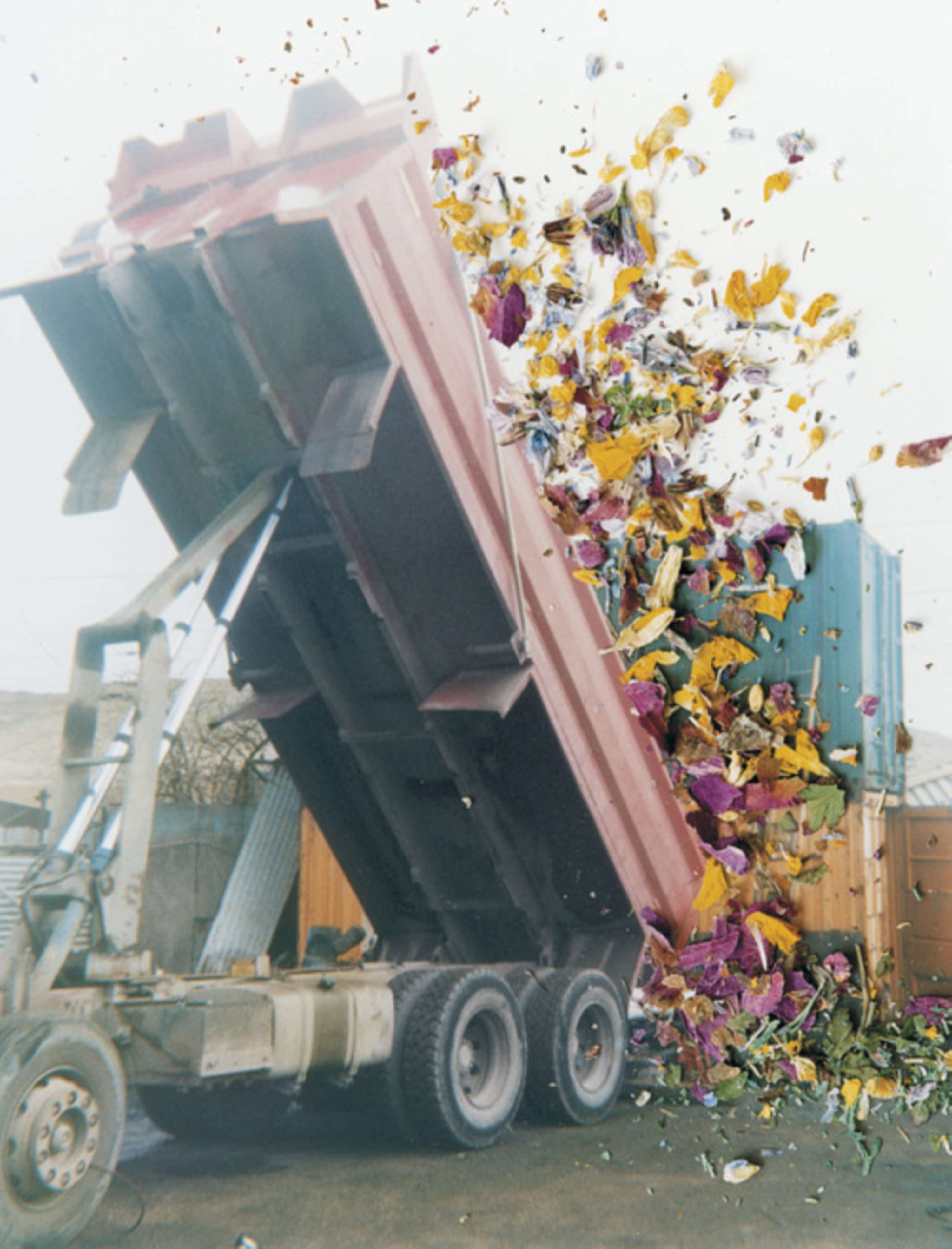
Stephen Gill explored Hackney, by collecting flowers, shrubs and berries from its streets, he took his own older images of Hackney, and positioned the objects on top. He then rephotographed the images. The way he has positioned the objects, really compliments the images. It created an extra dimension to the image, and creates depth. He stated that, “Hackney is constantly changing, as is photography” (Gill, cited in Contreras). One image I like is the dumper truck (see fig. 1), it shows flower pouring out of the back as it is lifted. It gives a alternative vibrant view. The original photograph is not of brilliant quality, and the focus is drawn to the flowers, so that doesn’t really effect the overall finished image, but the difference between the layer is obvious, whether this is Gills intention or not, I am not sure.
(Fig. 1. Hackney Flowers (2005-2007))
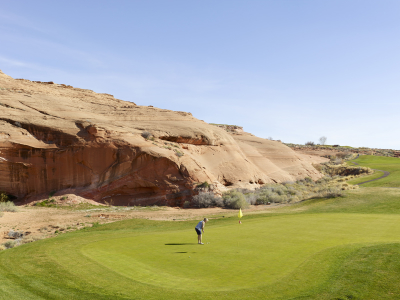
Mark Power is a British photographer, born in 1959. He has travelled to America for several projects. Good Morning, America: AZ/UT/NV, examines places that have been effected by climate change. Page, Arizona, shows a golf course is particularly meaningful (see fig. 2).
(Fig. 2. Page, Arizona (2017))
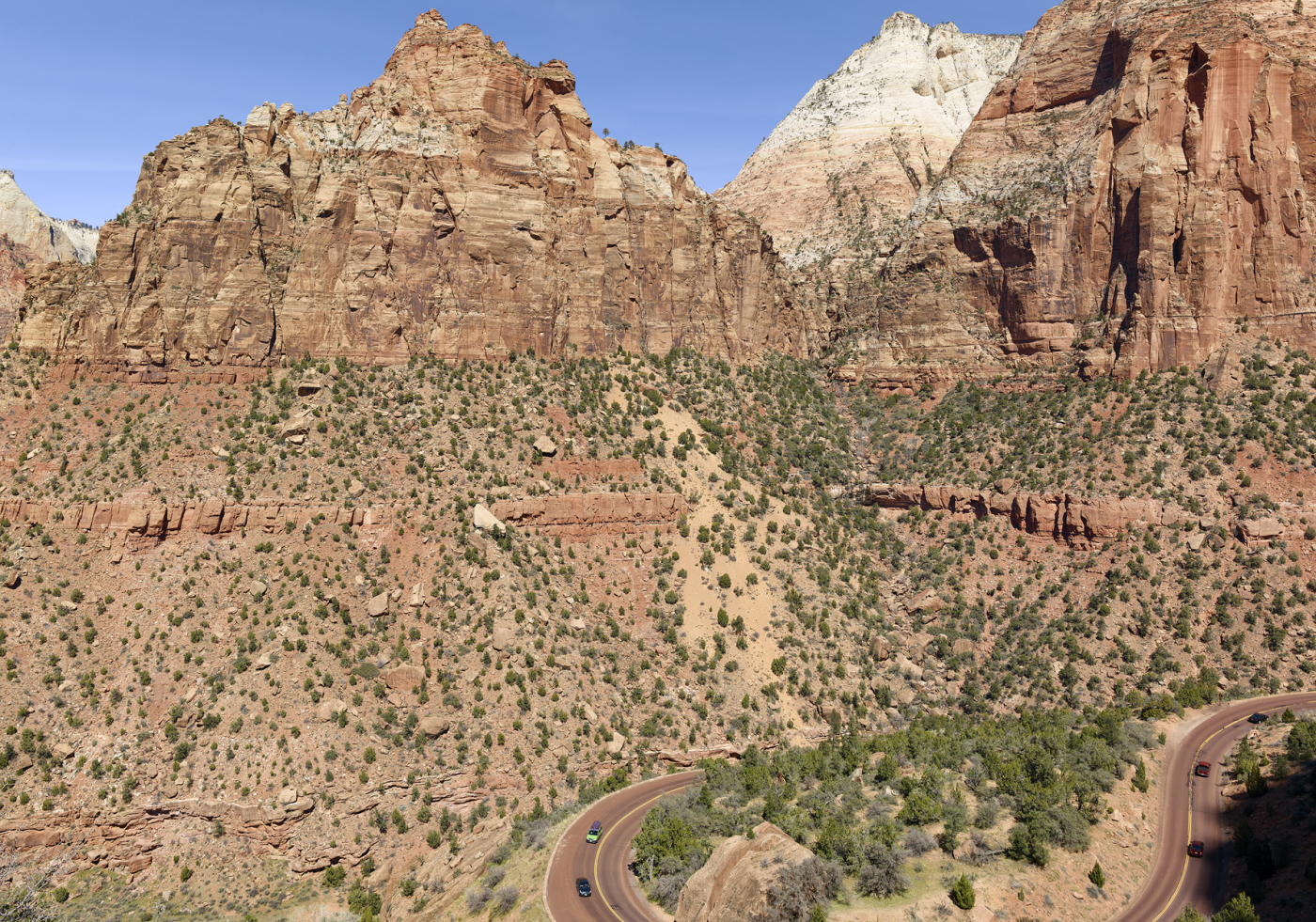
The lush green course is surround by dry arid dessert. There is a person playing golf, oblivious to the resources that went into creating and maintaining that course. Another image from, called Zion National Park, Utah, shows an untouched mountainous dry wasteland, untouched except for a road running around the mountains cutting straight through the scene (see fig. 3).
(Fig. 3. Zion National Park, Utah (2017))
With psychogeography, I believe yes you can take an objective view. All artists will have a goal or a plan when approaching a project. Their aim is important. It influences their methods and view of the place. I don’t think it does matter as such, as a lot of art is about the artists aim and the viewers interpretation.
Psychogeography will play a big role in my Body of Work project, as it involves at its basis following a pilgrimage.


 Georgina's Body of Work